


UPDATE: EsoRepair is selling out due to high demand. Secure your bottle on the official site only. [ORDER HERE]

You feel it after every meal. The burning that climbs from your stomach into your chest. The acid that crawls up your throat at 2 AM. The tightness when you swallow. The cough nobody can explain.
You've been told it's acid reflux. You've been given a pill. And for a while, maybe it helped.
But the symptoms keep coming back. And lately, they've been getting worse.
Here's what nobody explained clearly: acid reflux isn't just a symptom you manage. It's a progressive tissue injury. Every time acid splashes against your esophageal lining, it damages cells that were never designed to handle it. Inflammation follows. The lining weakens. And the next episode hits tissue that's more fragile than before [1].
This isn't about heartburn anymore. This is about what's happening to the tissue inside your esophagus — and what happens if nobody addresses it.
Your stomach has a thick mucus shield that protects it from its own acid. Your esophagus has no such protection [2].
When your lower esophageal sphincter weakens or relaxes at the wrong time, acid splashes upward into bare tissue. Here's what happens next:
Stage 1: Acute irritation. Acid contacts unprotected esophageal cells. You feel burning, chest pressure, maybe a sour taste. Most people reach for an antacid and move on.
Stage 2: Chronic inflammation. Repeated acid exposure triggers an inflammatory response. Your body sends immune cells to the area, but instead of healing, the inflammation itself accelerates tissue breakdown [1]. The lining becomes red, swollen, and increasingly fragile.
Stage 3: Barrier breakdown. The mucosal barrier — your esophagus's thin natural defense — starts to fail. Now even small amounts of acid that a healthy esophagus would brush off cause disproportionate pain. This is why symptoms seem to worsen over time even when your diet hasn't changed.
Stage 4: Progressive damage. Without tissue support, the cycle accelerates. Erosions form. Scar tissue builds. The esophagus may narrow. Cells can begin to change in ways that require medical monitoring [3].
This is not a linear timeline — it's a cycle. Each stage feeds the next. And at no point does reducing acid alone reverse the tissue damage that's already occurred.

Most people normalize their symptoms for years before realizing the damage has been building. Here's what progressive esophageal injury actually looks like:
- Burning that's getting worse, not better — even on medication. The tissue is more sensitive because the barrier is thinner.
- Symptoms spreading beyond your chest — throat burning, hoarseness, a cough that won't quit, sore throat every morning. Acid is reaching higher.
- Nighttime attacks increasing — waking with acid in your mouth, sleeping propped up, choking at 2 AM. Lying flat lets gravity work against you.
- Swallowing getting harder — food feels stuck, pills scrape, you drink water between every bite. Inflammation is narrowing the passage.
- Chest pain that scares you — pressure, tightness, pain down your arm. Your esophagus shares nerve pathways with your heart.
- The mental weight — fear before meals, avoiding restaurants, the growing sense that your world is shrinking around this condition.
Nearly 1 in 4 American adults experience recurring acid reflux symptoms [4]. GERD rates have climbed roughly 30% over the past two decades [5]. And up to 6 in 10 people with reflux-related tissue issues experience throat symptoms without ever feeling classic "heartburn" [6].
If you checked even one symptom above, the damage cycle is already in motion.
PPIs and antacids reduce acid. That's their job, and they do it well. For many people, they provide real relief.
But here's what the research shows about the limits of acid suppression alone:
Up to 40% of people on maximum-dose acid blockers still have persistent symptoms [7]. Why? Because acid reduction addresses the trigger — but not the damage it's already caused.
Think of it this way: if your roof has been leaking for years, turning off the rain helps. But the water damage inside the walls is still there. The mold is still growing. The structure is still weakened.
Your esophageal lining is the wall. Acid blockers turn off the rain. But the tissue inside still needs support to recover — and nothing in most treatment plans addresses that.
Meanwhile, long-term acid suppression has been associated with reduced absorption of key nutrients including magnesium, calcium, and vitamin B12 [8]. And when you stop the medication, rebound acid hypersecretion can make symptoms surge back worse than before [9].
The gap: nobody is supporting the tissue itself. That's the piece most approaches miss entirely.

That question is what drove a gastroenterologist specializing in esophageal mucosal health to develop EsoRepair.
The core insight: you can't support esophageal tissue with a pill that skips past it. Capsules and tablets drop straight to the stomach. The tissue that needs help — your esophageal lining — never gets contact with the active ingredients.
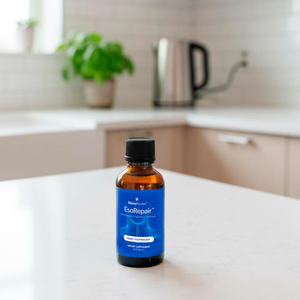
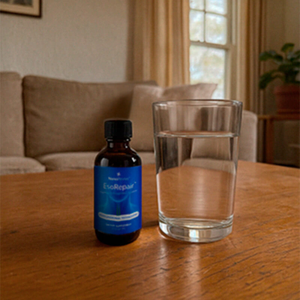
EsoRepair is a liquid formula you sip slowly. As it moves down, nano-sized particles of soothing botanicals and tissue-support compounds coat the esophageal lining on contact. It's not just what's in the formula — it's how it gets there.
Three mechanisms working together:
- COAT — Marshmallow root, slippery elm, and alginate form a physical mucilage layer that shields irritated tissue from acid on contact
- SUPPORT — Zinc-L-Carnosine, glutamine, hyaluronic acid, and chondroitin sulfate support the tissue that's been weakened by years of acid exposure
- PROTECT — Alginate creates a raft above stomach contents. Quercetin provides antioxidant support. DGL licorice boosts natural mucus production
60% Less Tissue Damage
Zinc-L-Carnosine reduced severe esophageal issues during oxidative stress [10]
4.4x More Relief
Sodium alginate outperformed placebo for reflux symptoms [11]
53% Better Comfort
HA + chondroitin sulfate improved outcomes added to standard care [12]
55% Symptom Reduction
Concentrated aloe vera matched a prescription acid blocker in trials [13]
*Results based on published studies of individual ingredients. Doses and forms may differ. Individual results vary. Not intended to diagnose, treat, cure, or prevent any disease.
Zinc-L-Carnosine (PepZin GI) — 75 mg
Adheres to damaged esophageal tissue and supports integrity during oxidative stress. Targets Stage 2 — chronic inflammation.
Sodium Alginate — 30 mg
Creates a protective raft above stomach contents, reducing how much acid reaches your esophagus. Targets Stage 1 — acute irritation.
Hyaluronic Acid (100 mg) + Chondroitin Sulfate (50 mg)
Form a soothing, film-like coating over raw esophageal tissue. Targets Stage 3 — barrier breakdown.
Marshmallow Root (200 mg) + Slippery Elm (200 mg)
High-mucilage botanicals that form a protective blanket on contact. Targets Stage 1 and 2 — immediate soothing and inflammation support.
Aloe Vera Inner-Leaf Gel 200:1 (10 mg) + DGL Licorice (150 mg)
Concentrated aloe supports digestive comfort. DGL boosts protective mucus production. Targets Stage 3 — barrier rebuilding.
L-Glutamine (250 mg) + Vitamin D3 (2,000 IU)
Glutamine is the primary fuel for esophageal lining cells. Vitamin D3 supports a healthy inflammatory response. Targets Stage 4 — progressive damage prevention.
Quercetin (125 mg) + Zinc (16.5 mg)
Quercetin is a plant flavonoid with antioxidant properties. Zinc supports tissue maintenance. Targets Stage 2 and 4 — oxidative stress defense.
Tissue that's been damaged for months or years doesn't recover overnight. EsoRepair is designed as a structured 90-day protocol — each phase targeting a different stage of the damage cycle:

Protective botanicals and zinc begin coating tissue on contact, creating a physical barrier between acid and your esophageal lining. Users describe less burning after meals, smoother swallowing, and fewer nighttime disruptions. You're interrupting Stage 1 — stopping new damage from landing on vulnerable tissue.

Hyaluronic acid, chondroitin sulfate, and glutamine provide ongoing tissue support. Many users report more confidence eating — less second-guessing, fewer "what if this triggers it" moments. You're addressing Stage 3 — supporting the barrier that's been breaking down.

Aloe vera, DGL licorice, and quercetin support mucosal resilience and a healthy inflammatory response. Steadier comfort, fewer trigger days. You're addressing Stage 2 — calming the inflammatory response that accelerates breakdown.

Your esophagus is functioning differently. The damage cycle that's been accelerating for months or years has been interrupted at every stage. Users describe meals becoming normal again — not a threat, not a calculation, just food.
Backed by a 90-day money-back guarantee. If you don't see a meaningful difference, full refund. No questions.

"I went to the ER twice because the chest burn felt like heart issues. I'd wake up with acid in my mouth every morning and sleep sitting up. Four weeks in, I slept through the night for the first time in years. The panic and palpitations are finally quiet."
"Nothing touched the lump-in-throat feeling. Food felt stuck, my voice was hoarse, and lying flat was impossible. This is the first thing that actually soothed my esophagus. Within weeks, swallowing felt normal and my voice came back."

"These issues wrecked my mental health. I was 51 and hopeless, terrified of every meal and living in constant flare-up fear. Two months in, I can eat without rehearsing disaster. I feel calmer, clearer, and like myself again."
"How is this different from my acid blocker?"
Different jobs. Acid blockers reduce acid production — that's important. EsoRepair coats, soothes, and supports the esophageal tissue that acid has already damaged. They address different parts of the problem and can be used together.
"How long before I feel a difference?"
Most users report initial comfort improvements in weeks 1-3 as the mucilage botanicals begin coating tissue. Meaningful tissue support builds progressively over 90 days. The 90-day guarantee gives you the full window risk-free.
"Why liquid instead of pills?"
Your esophagus is the tissue that needs help. Pills skip past it in seconds. EsoRepair is sipped slowly so the active ingredients actually contact and coat the esophageal lining on the way down. The format IS the differentiator.
"It's expensive. I've already spent so much."
$1.63/day on subscription. People with chronic reflux spend roughly twice as much on healthcare as those without it [14]. The 90-day guarantee means you're not risking anything.
"I don't want a subscription."
Cancel anytime. No commitments. Start with a single bottle.

- Doctor-formulated with 11 research-backed ingredients
- Liquid nano delivery — coats esophageal tissue directly
- 3 mechanisms: Coat + Support + Protect
- 90-day money-back guarantee
- Save up to 58% on subscription (cancel anytime)
Your esophagus has been absorbing damage for months — maybe years. The lining is thinner. The inflammation is deeper. The symptoms are worse than they used to be. And nothing in your current routine is addressing the tissue itself.
EsoRepair was built for exactly this moment. The moment you stop managing symptoms and start supporting the tissue underneath. Try it risk-free with 30% OFF.
[1] Orlando RC. Pathophysiology of gastroesophageal reflux disease. Am J Med Sci. 2003.
[2] Merck Manual. Esophagus lacks the protective lining the stomach has.
[3] StatPearls GERD. Esophageal reflux may result in esophagitis, stricturing, dysphagia, and Barrett esophagus.
[4] PMC6140167. GERD affects 18-28% of North American adults.
[5] PMC10658748. GERD prevalence increasing globally, rising roughly 30% over past 2 decades.
[6] PMC7465150. 20-60% of GERD patients have head and neck symptoms without classic heartburn.
[7] El-Serag H, et al. Persistent reflux symptoms on PPI therapy. Aliment Pharmacol Ther. 2010.
[8] PMC5557164. Long-term PPI use associated with bone fractures, B12 deficiency, nutrient malabsorption.
[9] Reimer C, et al. PPI therapy induces acid-related symptoms after withdrawal. Gastroenterology. 2009.
[10] Hayashi K, et al. Polaprezinc protects against esophagitis. Int J Clin Oncol. 2016.
[11] Leiman DA, et al. Alginate therapy for GERD. Dis Esophagus. 2017.
[12] Savarino V, et al. HA and chondroitin sulfate in NERD. Aliment Pharmacol Ther. 2017.
[13] Panahi Y, et al. Aloe vera syrup for GERD. J Tradit Chin Med. 2015.
[14] PMC6140167. GERD patient healthcare costs are 2x those of comparable patients without GERD.

- 90-day money back guarantee
- Best-selling esophageal support formula
- Up to 58% off on subscription
- Limited supply, order fast
- 30% OFF today only