


UPDATE: EsoRepair™ is selling out due to high demand. Secure your bottle on the official site only. [ORDER HERE]

You walked into the GI office expecting answers for your reflux. You walked out with a diagnosis that changed how you think about your body.
Barrett's esophagus.
Your doctor explained that your esophageal cells have changed years of acid damage have caused the lining to transform. They scheduled surveillance endoscopies. They told you to stay on your PPI. They told you to come back in a year.
But between those appointments, you're left with a question nobody answers: "What can I actually DO to support my esophagus right now?"
Not just reduce acid. Not just avoid triggers. But actively support the tissue that's already been damaged the tissue that your doctor is now watching every 6 to 12 months.
If you've been diagnosed with Barrett's and feel like you're just waiting between scopes, this article is for you.

Your esophagus is normally lined with flat, squamous cells similar to the inside of your cheek. After years of acid exposure, those cells can change into a different type cells that look more like your intestinal lining. This change is called intestinal metaplasia [1].
Your body is essentially trying to protect itself. The intestinal-type cells are more acid-resistant than normal esophageal cells. But this adaptation comes at a cost: these changed cells can sometimes undergo further changes over time from metaplasia to dysplasia (abnormal growth) to potentially more serious conditions [2].
Here's what the numbers say:
- 10-15% of people with chronic GERD develop Barrett's esophagus [3]
- Barrett's typically takes 5-10 years of chronic reflux to develop
- The vast majority of Barrett's patients never progress to serious complications progression rate is estimated at 0.1-0.5% per year [4]
- But the risk is real enough that every Barrett's patient is placed on surveillance
That's why you're getting scoped every year. Your doctor is watching for changes. The question is: what are you doing to support the tissue between those scopes?

According to gastroenterology guidelines, managing Barrett's has three objectives [5]:
Goal 1: Stop the reflux.
PPIs reduce acid production. This is standard care for every Barrett's patient, and it's important. PPIs are recommended regardless of whether you still have symptoms.
Goal 2: Support tissue health and mucosal recovery.
This is where the gap lives. PPIs reduce acid but they don't coat, soothe, or directly support the esophageal lining that's already undergone changes. The tissue that's being watched every year? Nothing in most treatment plans actively supports it between scopes.
Goal 3: Slow or halt further cellular changes.
This means reducing the ongoing assault on tissue acid AND bile, oxidative stress AND inflammation. PPIs address acid. But research shows that bile reflux (not just acid) plays a significant role in Barrett's progression [6]. And standard PPIs don't address bile.
Most Barrett's patients are only covered on Goal 1. Goals 2 and 3 are where proactive tissue support can fill a real gap.

Here's something your GI doctor knows but may not have explained in detail:
Chronic acid reflux doesn't just burn tissue. It generates reactive oxygen species (ROS) unstable molecules that damage DNA, accelerate cell death, and trigger inflammatory cascades [7]. In Barrett's tissue specifically, research has found elevated oxidative stress markers and reduced antioxidant defenses.
This matters because oxidative stress is one of the key drivers of cellular change in Barrett's tissue. It's the mechanism through which chronic reflux can push cells toward further abnormalities.
What fights oxidative stress? Antioxidants. And several of the ingredients in EsoRepair™ were selected specifically for their antioxidant and tissue-protective properties:
- Quercetin — a plant flavonoid with documented antioxidant and anti-inflammatory effects
- Zinc-L-Carnosine — adheres to damaged tissue and has shown protective effects during oxidative stress [8]
- Vitamin D3 — supports a healthy inflammatory response
- Aloe Vera — concentrated inner-leaf gel with antioxidant properties

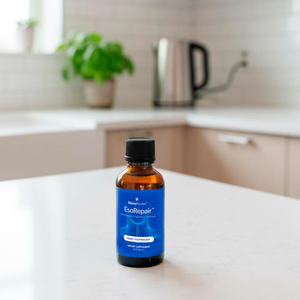
EsoRepair™ was developed by a gastroenterologist specializing in esophageal mucosal health. It's designed as a complement to your existing Barrett's management plan not a replacement.
Here's what makes it relevant for Barrett's patients specifically:
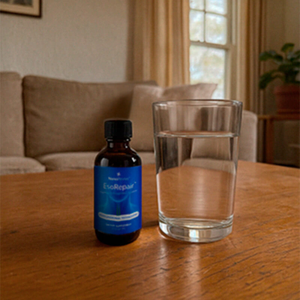
It's a liquid you sip slowly. Unlike pills that skip past the esophagus, EsoRepair™ coats the lining on the way down the exact tissue your doctor is monitoring.
It addresses multiple mechanisms:
- Sodium alginate creates a protective "raft" above stomach contents and research shows alginates also inhibit pepsin and bile salts, not just acid [9]
- Marshmallow root + slippery elm form a mucilage coating that physically shields tissue on contact
- Hyaluronic acid + chondroitin sulfate create a film-like barrier over sensitive esophageal areas
- Zinc-L-Carnosine adheres to compromised tissue and supports integrity during oxidative stress
- Quercetin provides antioxidant support directly relevant to the oxidative stress pathway in Barrett's
- L-Glutamine fuels the cells that line the esophagus the building blocks of tissue renewal
Important: EsoRepair™ is not a treatment for Barrett's esophagus. It does not replace PPIs, surveillance endoscopies, or any medical intervention. It's designed to provide daily tissue-level support between appointments the kind of support most Barrett's patients aren't getting.
60% Less Tissue Damage
Zinc-L-Carnosine protected esophageal tissue during oxidative stress [8]
Alginates Block Bile + Pepsin
Research shows alginates inhibit bile salts and pepsin — not just acid [9]
53% Better Comfort
HA + chondroitin sulfate improved outcomes added to standard care [10]
55% Symptom Reduction
Concentrated aloe vera matched a prescription acid blocker in trials [11]
*Results based on published studies of individual ingredients. Doses/forms may differ. Individual results vary. EsoRepair™ is not a treatment for Barrett's esophagus and does not prevent, treat, cure, or diagnose any disease.
EsoRepair™ is designed as a structured 90-day protocol alongside your existing Barrett's care plan:

Mucilage-forming botanicals and alginate begin coating the esophageal lining. Users describe less post-meal discomfort and fewer breakthrough reflux episodes even on PPIs.

Hyaluronic acid, chondroitin sulfate, and glutamine provide ongoing tissue support. Many users report improved swallowing comfort and less anxiety about what they eat.

Quercetin, aloe vera, and DGL licorice provide antioxidant and mucosal support. Users report feeling more proactive about their condition — doing something meaningful between scopes.

After 90 days of daily tissue support, users describe walking into their next endoscopy with less dread and more confidence that they've been actively supporting the tissue their doctor is watching.
Backed by a 90-day money-back guarantee. If you don't see a meaningful difference, full refund.

"I went to the ER twice because the chest burn felt like heart issues. I'd wake up with acid in my mouth every morning and sleep sitting up. Four weeks in, I slept through the night for the first time in years. The panic and palpitations are finally quiet."

"These issues wrecked my mental health. I was 51 and hopeless, terrified of every meal and living in constant flare-up fear. Two months in, I can eat without rehearsing disaster. I feel calmer, clearer, and like myself again."
"Nothing touched the lump-in-throat feeling. Food felt stuck, my voice was hoarse, and lying flat was impossible. This is the first thing that actually soothed my esophagus. Within weeks, swallowing felt normal and my voice came back."
"Will this reverse my Barrett's?"
EsoRepair™ is not a treatment for Barrett's esophagus and is not designed to reverse metaplasia. It's a daily tissue support formula designed to complement your existing medical care — providing the kind of esophageal coating, soothing, and antioxidant support that most Barrett's management plans don't include.
"I'm already on a PPI. Do I still need this?"
PPIs reduce acid production — and they're essential for Barrett's patients. EsoRepair™ addresses what PPIs don't: tissue coating, mucosal support, bile/pepsin protection, and antioxidant defense. They serve different functions and work together.
"Should I tell my GI doctor I'm taking this?"
Yes. We always recommend informing your healthcare provider about any supplement you add to your routine, especially with a diagnosed condition like Barrett's.
"How is a liquid better than a pill for Barrett's?"
Barrett's affects the esophageal lining. Pills skip past the esophagus in seconds. EsoRepair™ is sipped slowly — coating the tissue your doctor is monitoring with soothing, protective ingredients on the way down.
"It's expensive."
$1.63/day on subscription. Your surveillance endoscopies cost thousands. EsoRepair™ fills the gap between those appointments with daily tissue support. 90-day money-back guarantee — zero risk.

- Doctor-formulated with 11 research-backed ingredients
- Liquid nano delivery — coats the tissue your doctor is monitoring
- Alginate inhibits bile AND pepsin — not just acid
- Quercetin + Zinc for antioxidant tissue support
- 90-day money-back guarantee
You've been diagnosed. You're on a PPI. You're getting scoped every year. But between those appointments, you've been waiting — wondering if there's something more you can do.
EsoRepair™ was designed for exactly that space. Daily tissue support for the esophagus nobody else is actively helping. Try it risk-free with 30% OFF.
[1] Cleveland Clinic. Barrett's Esophagus: intestinal metaplasia as a protective adaptation to chronic acid injury.
[2] PMC3501769. Barrett's esophagus: management strategies; metaplasia → dysplasia → carcinoma sequence.
[3] PMC2921087. 10-15% of patients with GERD develop Barrett's esophagus.
[4] PMC3501769. Progression rate estimated at 0.1-0.5% per year in large cohort studies.
[5] PMC2921087. Three goals: stop reflux, promote mucosal healing, halt progression.
[6] PMC6327172. Bile salts in refluxed duodenal juice play significant role in Barrett's development and progression.
[7] Scarpignato & Wang 2021. Acid reflux → ROS → DNA damage → increased cell proliferation in Barrett's tissue.
[8] Hayashi K, et al. Polaprezinc protects against esophagitis. Int J Clin Oncol. 2016.
[9] PMC9012673. Alginates inhibit pepsin and bile salts; improve symptoms as adjunct to PPI therapy.
[10] Savarino V, et al. HA–chondroitin sulfate in NERD. Aliment Pharmacol Ther. 2017.
[11] Panahi Y, et al. Aloe vera syrup for GERD. J Tradit Chin Med. 2015.

- 90-day money back guarantee
- Best-selling esophageal support formula
- Up to 58% off on subscription
- Limited supply, order fast
- 30% OFF today only